On the Natural Man
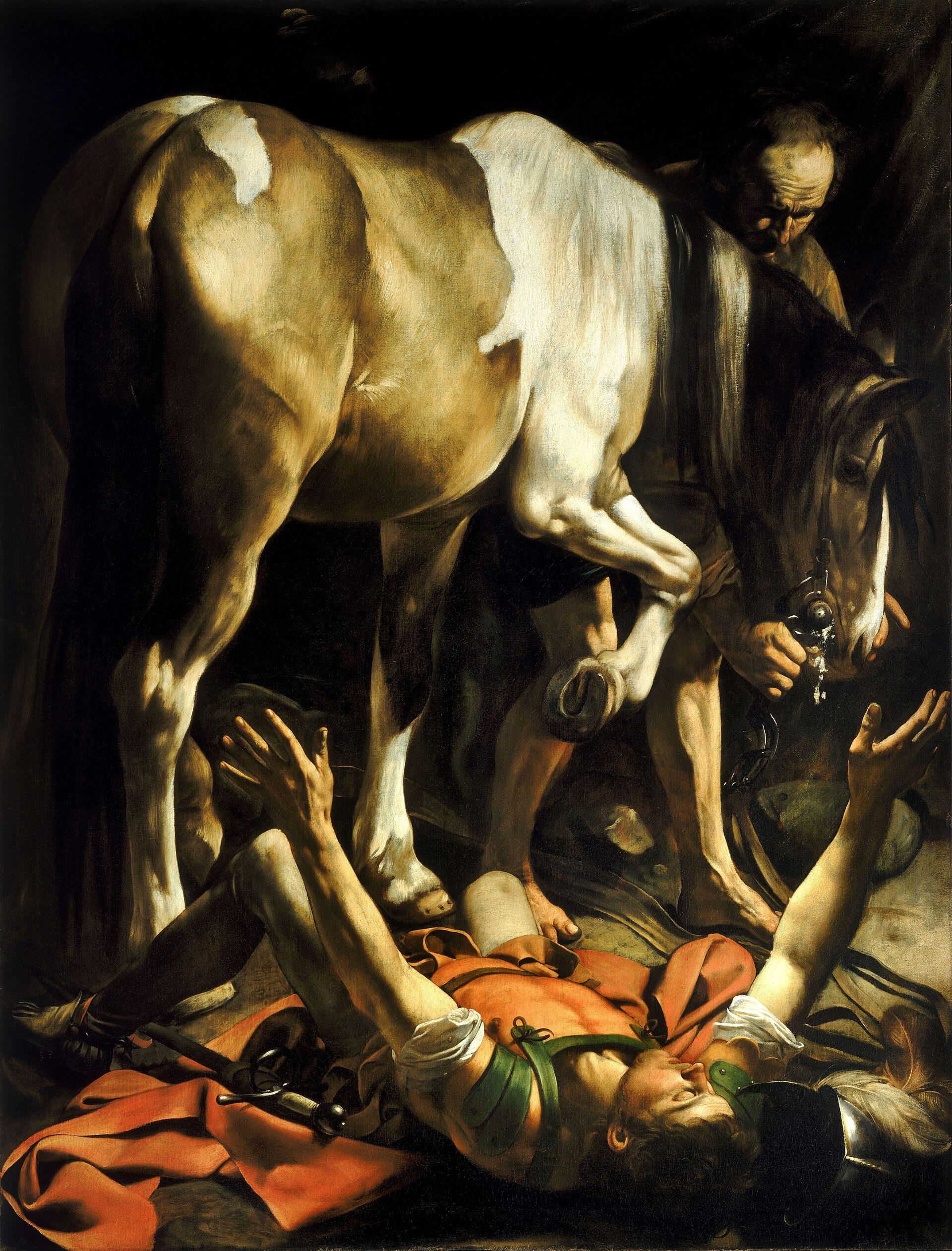
Conversion on the Way to Damascus by Caravaggio1
Every Latter-day Saint knows this verse. It gets quoted in talks, in lessons, and on refrigerator magnets:
19 For the natural man is an enemy to God, and has been from the fall of Adam, and will be, forever and ever, unless he yields to the enticings of the Holy Spirit, and putteth off the natural man and becometh a saint through the atonement of Christ the Lord, and becometh as a child, submissive, meek, humble, patient, full of love, willing to submit to all things which the Lord seeth fit to inflict upon him, even as a child doth submit to his father.2
We read it as a warning about appetite. The natural man is the one who eats too much, sleeps in, loses his temper. Put him off and be better. Easy-peasy.
That is not solely what Benjamin is describing. He is also describing a location.
Cut Off
The Book of Mormon says what the natural man is, and it says it in the same words three separate times.
Alma, explaining the fall to his son:
9 …the fall had brought upon all mankind a spiritual death as well as a temporal, that is, they were cut off from the presence of the Lord… 10 Therefore, as they had become carnal, sensual, and devilish, by nature, this probationary state became a state for them to prepare.3
Samuel the Lamanite, from the wall:
16 …for all mankind, by the fall of Adam being cut off from the presence of the Lord, are considered as dead, both as to things temporal and to things spiritual.4
Jacob, at the temple in Nephi:
6 …and because man became fallen they were cut off from the presence of the Lord.5
We have three witnesses all using one phrase with no ambiguity. And notice that Alma sets by nature directly beside cut off, one verse apart. That is the same word Benjamin used, in the same sense, and with the same meaning attached.
The natural man is not just a man with a discipline problem. He is a man on the wrong side of a door. Samuel goes further than that and says he is considered as dead, which is not a description of behavior at all. It is a description of standing.
What “Natural” Meant
To get a sense of the meaning of words at the time the Book of Mormon was published in 1830 we can use Webster’s 1828 dictionary. Webster begins the entry for natural with its etymology: to be born or produced6.
The word is not about appetite. It is about origin. The natural man is the man you get by default, with nothing added. Webster’s eighth sense says it plainly: “produced or coming in the ordinary course of things.” Nobody has to do anything to become the natural man. You arrive that way, and Alma says all mankind arrived that way together.
Then keep reading down the entry. Webster’s eleventh sense of natural is this:
Illegitimate; born out of wedlock; as a natural son.7
In the English of Joseph Smith’s own period, a natural son is a son the father has not claimed. He may be a son in fact. He has no standing as one. No name, no inheritance, no legal claim on the house.
The writer of Hebrews uses exactly that word:
8 But if ye be without chastisement, whereof all are partakers, then are ye bastards, and not sons.8
And Joseph Smith quoted it to a congregation who had just called him a fallen prophet9. Not sons. Cut off from the presence of the Lord, and with no claim on the house besides.
The Opposite of Friendship
Now the other word Benjamin chose.
Webster defines enmity as “the quality of being an enemy; the opposite of friendship; ill will; hatred”10.
Consider that for a moment. The dictionary defines the bottom by pointing at the top. Enemy and friend are not two items on a list. They are two ends of one measurement.
James says it in a single verse and uses both words to do it:
4 know ye not that the friendship of the world is enmity with God? whosoever therefore will be a friend of the world is the enemy of God.11
Friend of the world, enemy of God. You are always the friend of something and the enemy of something else. The question was never whether you have a position. The question is which direction you are facing.
Paul puts it in the mind rather than the appetite: “the carnal mind is enmity against God”12. Not the carnal body. The mind.
Brought Back
Samuel does not leave the man outside the door.
17 But behold, the resurrection of Christ redeemeth mankind, yea, even all mankind, and bringeth them back into the presence of the Lord.13
Cut off, and brought back. That is the whole transaction, and notice who performs both halves of it. Nobody in these verses climbs back in.
Paul says the same thing and is careful about the timing:
8 But God commendeth his love toward us, in that, while we were yet sinners, Christ died for us. 10 For if, when we were enemies, we were reconciled to God by the death of his Son.14
While we were yet sinners. When we were enemies. Not after we stopped. He tells the Colossians they “were sometime alienated and enemies in your mind by wicked works, yet now hath he reconciled”15. And he tells the Ephesians that Christ came “having slain the enmity”16.
Slain. The enmity is not negotiated with. It is killed, and Christ is the one holding the knife.
Two Men Who Would Know
Two of the men who tell us the most about becoming the sons and daughters of God were enemies first.
The first was an enemy in the plainest sense of the word. Not carnal in the way we mean it when we are being polite. An organized opponent:
10 And he became a great hinderment to the prosperity of the church of God; stealing away the hearts of the people; causing much dissension among the people. 11 And now it came to pass that while he was going about to destroy the church of God…17
That is Alma the Younger. Years later, telling the story to his own son, he did not soften it:
14 Yea, and I had murdered many of his children, or rather led them away unto destruction; yea, and in fine so great had been my iniquities, that the very thought of coming into the presence of my God did rack my soul with inexpressible horror. 15 Oh, thought I, that I could be banished and become extinct both soul and body, that I might not be brought to stand in the presence of my God, to be judged of my deeds.18
Murder. His word, not mine.
Then read what he says about the presence of God, twice in two verses. He is not being held outside against his will. He would rather be annihilated than be brought back in. That is what being cut off finally does to a man. It is not only a door that shuts. After long enough it is a door you no longer want opened.
Fifteen verses after that angel found him, back in Mosiah, the same man says this:
25 …all mankind, yea, men and women, all nations, kindreds, tongues and people, must be born again; yea, born of God, changed from their carnal and fallen state, to a state of righteousness, being redeemed of God, becoming his sons and daughters; 26 And thus they BECOME new creatures.19
Enemy to son, in one chapter, in one man. And notice how it began. I fell to the earth.
The second man fell to the earth too.
The second is the man in the painting at the top of this post. Saul of Tarsus was on the road to Damascus carrying letters that authorized arrests when the thing happened that Caravaggio painted. He later described himself as having been “a blasphemer, and a persecutor, and injurious”20.
Look at what Caravaggio actually shows you. Saul is flat on his back with his arms up and his eyes closed. The horse is enormous and entirely calm. The groom holding the bridle has not noticed anything at all. Nobody is being punished in that picture. Saul is not struck down. He is dismounted.
And this man, this persecutor, is the one who writes almost everything we have about adoption, about heirship, about being no more a servant but a son21.
The people who tell us the most about becoming sons of God are ex-enemies. I do not think that is an accident. I think it is meant to show us where the road starts.
What He Is Missing
Put the two words back together.
The natural man is cut off from the presence of the Lord, and he did not get there by misbehaving. He was born there. He is facing the wrong way, he is considered as dead, and he has no legal claim on the house he was born near. And the enmity that defined him has already been slain by somebody who did it while he was still swinging.
Which leaves a question, and it is not a question about behavior.
If a man has no standing, what would it take to give him some?
That has an answer. It has a name, and the name is older than we remember. That is the next post.
But what do I know? I don’t know, Jack.
-
Conversion on the Way to Damascus by Caravaggio (Michelangelo Merisi da Caravaggio, 1571–1610), painted about 1600–1601 for the Cerasi Chapel in Santa Maria del Popolo, Rome, where it still hangs. Public domain, via Wikimedia Commons. ↩︎
-
Mosiah 3:19. These are the angel’s words, delivered by King Benjamin. Two verses earlier: “men drink damnation to their own souls except they humble themselves and become as little children, and believe that salvation was, and is, and is to come, in and through the atoning blood of Christ, the Lord Omnipotent. For there shall be no other name given nor any other way nor means whereby salvation can come unto the children of men, only in and through the name of Christ, the Lord Omnipotent” (Mosiah 3:17-18). ↩︎
-
Alma 42:9-10. Alma uses “cut off” five times in six verses. Verse 6: “as they were cut off from the tree of life they should be cut off from the face of the earth, and man became lost forever, yea, they became fallen man.” Verse 7: “our first parents were cut off both temporally and spiritually from the presence of the Lord; and thus we see they became subjects to follow after their own will.” Verse 11: “if it were not for the plan of redemption, (laying it aside) as soon as they were dead their souls were miserable, being cut off from the presence of the Lord.” ↩︎
-
Helaman 14:16 Yea, behold, this death bringeth to pass the resurrection, and redeemeth all mankind from the first death, that spiritual death; for all mankind, by the fall of Adam being cut off from the presence of the Lord, are considered as dead, both as to things temporal and to things spiritual. ↩︎
-
2 Nephi 9:6 For as death hath passed upon all men, to fulfil the merciful plan of the great Creator, there must needs be a power of resurrection, and the resurrection must needs come unto man by reason of the fall; and the fall came by reason of transgression; and because man became fallen they were cut off from the presence of the Lord. ↩︎
-
Natural, Webster’s 1828 dictionary. The etymology given is “to be born or produced.” Sense 1 is “produced or effected by nature, or by the laws of growth, formation or motion impressed on bodies or beings by divine power.” Sense 8 is “produced or coming in the ordinary course of things.” ↩︎
-
Sense 11 of the same entry. This is the secondary sense of the adjective and belongs to the particular phrase, not to every use of the word. I am not claiming Benjamin means only this. I am pointing out that it was live in the language his translator was working in, and that Hebrews reaches for the same idea. ↩︎
-
Hebrews 12:8. The verses before it: “My son, despise not thou the chastening of the Lord, nor faint when thou art rebuked of him: For whom the Lord loveth he chasteneth, and scourgeth every son whom he receiveth. If ye endure chastening, God dealeth with you as with sons; for what son is he whom the father chasteneth not?” (Hebrews 12:5-7). ↩︎
-
Wilford Woodruff took the discourse down in his journal: “Some say Joseph is a fallen Prophet because he does not bring forth more of the word of the Lord… knowing that whom the Lord loveth he chasteneth & scourgeth evry son & daughter whom He receiveth & if we do not receive chastizments then are we Bastards & not Sons.” The spelling is Woodruff’s. Discourse of 19 December 1841 at the old homestead in Nauvoo, from Wilford Woodruff, Journal, vol. 4, pp. 115–116. See The Joseph Smith Papers, and the parallel notetaker accounts at josephsmithsermons.org. Compare Teachings of the Prophet Joseph Smith, p. 194. ↩︎
-
Enmity, Webster’s 1828 dictionary. Webster’s own illustrations for the word are Genesis 3:15, Romans 8:7, and James 4:4. ↩︎
-
James 4:4 Ye adulterers and adulteresses, know ye not that the friendship of the world is enmity with God? whosoever therefore will be a friend of the world is the enemy of God. ↩︎
-
Romans 8:7 Because the carnal mind is enmity against God: for it is not subject to the law of God, neither indeed can be. ↩︎
-
Helaman 14:17. The verse after it is worth having too: “whosoever repenteth the same is not hewn down and cast into the fire; but whosoever repenteth not is hewn down and cast into the fire; and there cometh upon them again a spiritual death, yea, a second death, for they are cut off again as to things pertaining to righteousness” (Helaman 14:18). ↩︎
-
Romans 5:8, 10. Verse 6 sets it up: “For when we were yet without strength, in due time Christ died for the ungodly.” And verse 10 finishes: “much more, being reconciled, we shall be saved by his life.” ↩︎
-
Colossians 1:21-22 And you, that were sometime alienated and enemies in your mind by wicked works, yet now hath he reconciled In the body of his flesh through death, to present you holy and unblameable and unreproveable in his sight. ↩︎
-
Ephesians 2:16 And that he might reconcile both unto God in one body by the cross, having slain the enmity thereby. See also verse 15, “having abolished in his flesh the enmity.” ↩︎
-
Mosiah 27:10-11. Verse 8 introduces him: “Now the sons of Mosiah were numbered among the unbelievers; and also one of the sons of Alma was numbered among them, he being called Alma, after his father; nevertheless, he became a very wicked and an idolatrous man.” ↩︎
-
Alma 36:14-15, Alma the Younger recounting his conversion to his son Helaman. The angel’s words in verse 11 were “If thou wilt be destroyed of thyself, seek no more to destroy the church of God,” at which “I was struck with such great fear and amazement lest perhaps I should be destroyed, that I fell to the earth and I did hear no more.” The turn comes in verses 17 and 18, when he remembers his father preaching “concerning the coming of one Jesus Christ, a Son of God, to atone for the sins of the world,” and cries out, “O Jesus, thou Son of God, have mercy on me, who am in the gall of bitterness, and am encircled about by the everlasting chains of death.” ↩︎
-
Mosiah 27:25-26. Alma is quoting what the Lord said to him. His own testimony is verse 24: “I have repented of my sins, and have been redeemed of the Lord; behold I am born of the Spirit.” ↩︎
-
1 Timothy 1:13 Who was before a blasphemer, and a persecutor, and injurious. The account of the road is in Acts 9:1-9: “And Saul, yet breathing out threatenings and slaughter against the disciples of the Lord, went unto the high priest, And desired of him letters to Damascus to the synagogues, that if he found any of this way, whether they were men or women, he might bring them bound unto Jerusalem… And he fell to the earth, and heard a voice saying unto him, Saul, Saul, why persecutest thou me?” ↩︎
-
Galatians 4:1-7 and Romans 8:14-17, chiefly. Galatians: “Now I say, That the heir, as long as he is a child, differeth nothing from a servant, though he be lord of all; But is under tutors and governors until the time appointed of the father. Even so we, when we were children, were in bondage under the elements of the world: But when the fulness of the time was come, God sent forth his Son, made of a woman, made under the law, To redeem them that were under the law, that we might receive the adoption of sons. And because ye are sons, God hath sent forth the Spirit of his Son into your hearts, crying, Abba, Father. Wherefore thou art no more a servant, but a son; and if a son, then an heir of God through Christ.” Romans: “For as many as are led by the Spirit of God, they are the sons of God. For ye have not received the spirit of bondage again to fear; but ye have received the Spirit of adoption, whereby we cry, Abba, Father. The Spirit itself beareth witness with our spirit, that we are the children of God: And if children, then heirs; heirs of God, and joint-heirs with Christ; if so be that we suffer with him, that we may be also glorified together.” There is a great deal in both of these, and I will come back to them. ↩︎
