On the 'Sons of God'
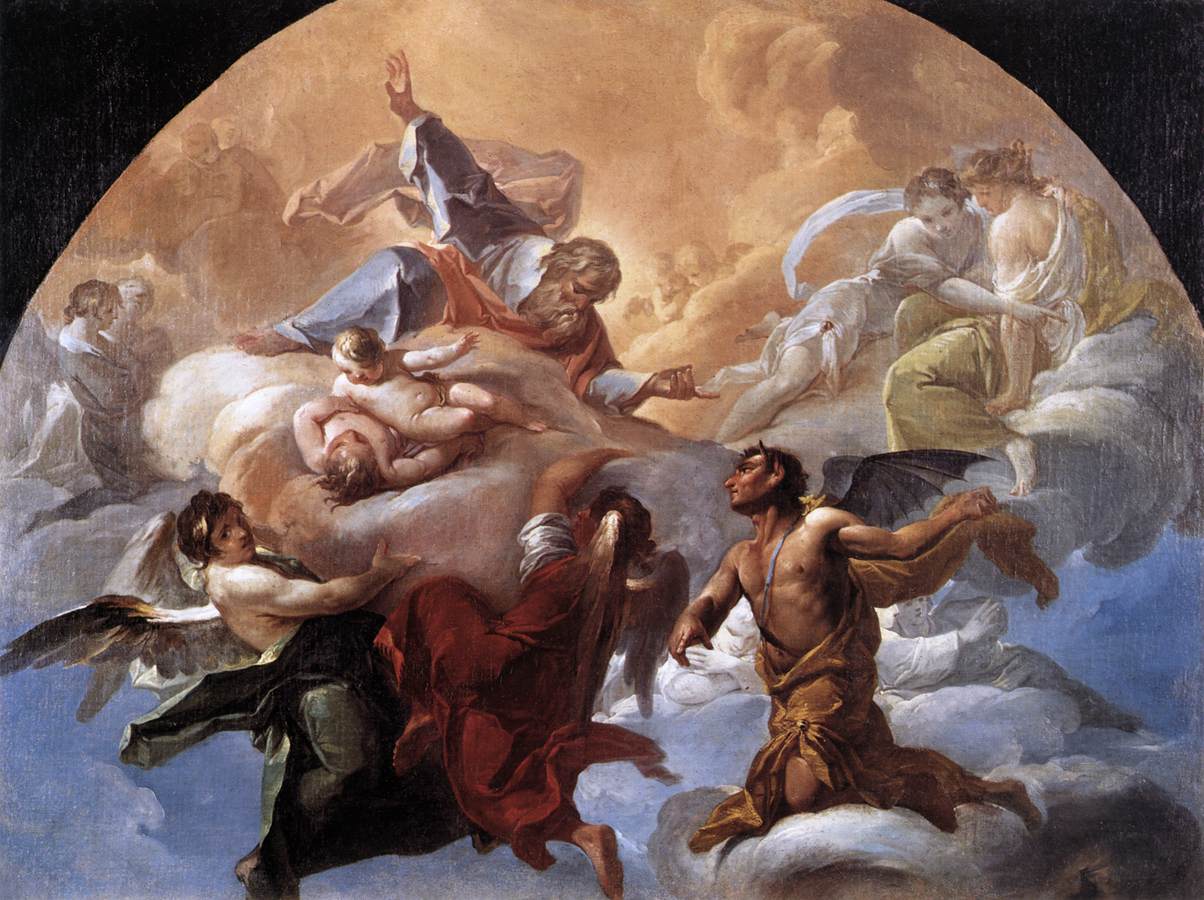
Satan before the Lord by Corrado Giaquinto1
There is an interesting episode that appears in the Book of Job that describes the ‘sons of God’ presenting themselves before the Lord2. This has led many to ask, “Who are these ‘sons of God’?” Certainly they include the angels. But is there anything else we can find out about them? Could the phrase ‘sons of God’ be describing something more? Maybe a status or rank? Let’s look into it.
Stolen Valor
In the Book of Moses, Noah and his sons hearkened unto the Lord, and subsequently they were called the ‘sons of God’3. It doesn’t appear to be something they were called before that time, but now they are. Contrast that with verse 144 where a different group of people appear: the sons of men. Then down in verse 20 and 21 we have the ‘sons of men’ claiming to also be the ‘sons of God’:
20 And it came to pass that Noah called upon the children of men that they should repent; but they hearkened not unto his words;
21 And also, after that they had heard him, they came up before him, saying: Behold, we are the sons of God; have we not taken unto ourselves the daughters of men? And are we not eating and drinking, and marrying and giving in marriage? And our wives bear unto us children, and the same are mighty men, which are like unto men of old, men of great renown. And they hearkened not unto the words of Noah.
It’s clear from verse 20 who these people are. They are the ‘children of men’, the same group verse 14 called the ‘sons of men’. They need repenting. Yet, here they are claiming to be the same status as Noah and his sons. They claim they need no repentance because they are also the children of God and doing all the same things as the great men that came before them. Yet, ‘they hearkened not unto the words of Noah’. What is going on here? It sounds more like a case of stolen valor5, claiming to be something that hasn’t been bestowed upon them.
So what actually made the difference between the two groups? The verse tells us plainly, and it is easy to read right past it. Noah and his sons ‘hearkened unto the Lord, and gave heed’. That’s it. That’s the whole distinction. One group hearkened. The other ‘hearkened not unto the words of Noah’ and the title followed the hearkening.
A Title Has to Be Given
Claiming to be a child of God doesn’t appear to mean a lot. You see, spiritually speaking, your father is whoever it is that you listen to and obey. Jesus describes the Pharisees as children of the devil when they claim to be children of God6. They were doing the same thing as the people Noah was preaching to. In their minds they were the righteous ones having no need for repentance.
Many people today do the same thing. They read Moses 1:47 and see Moses is declared to be a son of God and assume it’s a declaration of every man’s status instead of a specific declaration to Moses regarding his new relational status to God8. Sure, we are all the children of God and for many people that means something. But that meaning seems to be more sentimental than covenantal.
CS Lewis ran into the same problem and put a name to it. He noticed that Christians talk about becoming sons of God, and that this ought to strike us as strange, because we assume we already are. His answer turns on two words we hardly use anymore:
To BEGET is to become the father of: to create is to make… What God begets is God; just as what man begets is man. What God creates is not God; just as what man makes is not man.9
Making produces something of a different kind than the maker. A man makes a statue, and if he is good at it the statue looks very like a man. But it does not breathe. Begetting produces something of the same kind. Which leaves us, at the start, as the statue. Thus: Jesus was begotten of God and man was made in the image of God. Which means sonship is not where we start out. It is something that has to happen to us.
A bestowed title has to be bestowed by someone, at some time.
So those who keep the commandments of God ought to expect to have the words of Psalms 2:710 spoken to them at some point in their life. Personally.
If that sounds like something reserved for prophets in another age, read D&C section 34. In November 1830 a nineteen-year-old named Orson Pratt, six weeks baptized, was told that Christ gave his own life “that as many as would believe might become the sons of God.” The very next words are “Wherefore you are my son”11.
Down into the Water
There is another reason to expect it. We are expected to follow Jesus in all things, and Nephi is unusually direct about what that means. If the Lamb of God, being holy, still needed to be baptized, “how much more need have we, being unholy”? The point was never the water. The point is the pattern. “Follow me, and do the things which ye have seen me do”12.
So what did we see him do? He went down into the water. The Spirit descended. And a voice out of heaven made a declaration about who he was.
Section 93 is where this stops being comfortable. John’s record says that Christ “received not of the fulness at the first, but continued from grace to grace, until he received a fulness”. And then:
14 And thus he was CALLED the Son of God, because he received not of the fulness at the first.
Read that again. The reason given for the title is a process. The very next verse is the baptism, the dove, and the voice13.
And what the voice said may not be what your Bible says it said. A number of the earliest manuscripts, and several of the early Christian writers who quoted the passage, have the voice speaking Psalms 2:7 word for word: “Thou art my Son, this day have I begotten thee”14. You do not have to settle the manuscript question to see the point, because Paul settles it for us. Preaching at Antioch he takes that verse, names the psalm it comes from, and applies it to Christ15.
Then section 93 turns it on us:
20 For if you keep my commandments you shall receive of his fulness, and be glorified in me as I am in the Father; therefore, I say unto you, you shall receive grace for grace.
22 And all those who are BEGOTTEN through me are partakers of the glory of the same, and are the church of the Firstborn.
Grace for grace. The same way he did it.
The Father and the Son
Once you see it, you can’t unsee it. The doctrine of becoming a Son or Daughter of God is everywhere in the scriptures16. One such example can be found in Ether chapter three when The Brother of Jared encounters the Lord (Ether 3:14).
Behold, I am he who was prepared from the foundation of the world to redeem my people. Behold, I am Jesus Christ. I am the Father and the Son. In me shall all mankind have life, and that eternally, even they who shall believe on my name; and they shall BECOME my sons and my daughters.
It seems now that we are beginning to unravel one of the mysteries. How Jesus can both be the Father and the Son17.
And notice who is doing the begetting. “That by him, and through him, and of him, the worlds are and were created, and the inhabitants thereof are begotten sons and daughters unto God”18. By him. Through him. Of him.
Back to Job
Which brings us back to Job. If the title is bestowed, then what do we do with the sons of God who were already shouting for joy when the foundations of the earth were laid19?
Joseph Smith took up that question eleven days before he was killed. The text he preached from was Revelation 1:6, that Christ “hath made us kings and priests unto God and his Father”. Thomas Bullock took down these words:
I bel. in these Gods that God reveals as Gods-- to be Sons of God & all can cry Abba Father-- Sons of God who exalt themselves to be Gods even from bef the foundat[io]n. of the world & are the only Gods I have a reverence for-- John sd. he was a K.-- J. C. who hath by his own blood made us K & P. to God--20
Bullock was writing in shorthand, so read that as a notetaker’s report and not as Joseph’s exact words. But the gist of it is hard to miss. The sons of God at the creation were not there by default. They exalted themselves, even from before the foundation of the world. They arrived. Whatever else Job is showing us, it is not showing us a room full of people who were simply born into the room.
Sons of God, and kings and priests, in the same breath.
Sonship and Order
And this is not the first time those two things show up together. Go back to Moses chapter 6, to Adam. He is baptized, born of the Spirit, quickened in the inner man. Then a voice out of heaven tells him two things, back to back:
67 And thou art after the order of him who was without beginning of days or end of years, from all eternity to all eternity;
68 Behold, thou art one in me, a son of God; and thus may all BECOME my sons. Amen.
Order, then sonship21.
Then go back to Moses chapter 8 one last time. Six verses after Noah and his sons are called the sons of God, we are told that “the Lord ordained Noah after his own order”22. Sonship and order. Same chapter, six verses apart.
Twice. With the first man, and with the man who started the world over.
And if you want all of it said in one place, section 76 says it. Of those who belong to that same church of the Firstborn:
56 They are they who are priests and kings, who have received of his fulness, and of his glory;
57 And are priests of the Most High, after the order of Melchizedek, which was after the order of Enoch, which was after the order of the Only Begotten Son;
58 Wherefore, as it is written, they are gods, even the sons of God
Kings and priests. The order. Sons of God. With a wherefore tying it all together23.
Does this make D&C 107:3 mean something different to you now? When you become a Son (capital S) of God do you also join into that order24?
And if you do, is that the top of it? A son is an heir. But an heir can be an heir and still not be told what his Father is doing25. That is a different conversation, and one for another day.
But what do I know? I don’t know, Jack.
-
Satan before the Lord by Corrado Giaquinto (1703–1766). The scene is the heavenly council of Job 1–2. Public domain, via Wikimedia Commons. ↩︎
-
Job 1:6, 2:1 Now there was a day when the sons of God came to present themselves before the Lord, and Satan came also among them. ↩︎
-
Moses 8:13 And Noah and his sons hearkened unto the Lord, and gave heed, and they were called the sons of God. ↩︎
-
Moses 8:14 And when these men began to multiply on the face of the earth, and daughters were born unto them, the sons of men saw that those daughters were fair, and they took them wives, even as they chose. ↩︎
-
Stolen valor is a term for the behavior of military impostors: individuals who lie about serving in the military or the extent of their military service. ↩︎
-
John 8:41-44 Ye do the deeds of your father. Then said they to him, We be not born of fornication; we have one Father, even God. Jesus said unto them, If God were your Father, ye would love me: for I proceeded forth and came from God; neither came I of myself, but he sent me. Why do ye not understand my speech? even because ye cannot hear my word. Ye are of your father the devil, and the lusts of your father ye will do. ↩︎
-
Moses 1:4 And, behold, thou art my son… ↩︎
-
There is more to say about the doctrine of adoption, and it deserves a post of its own. Romans 8:15 reads, “For ye have not received the spirit of bondage again to fear; but ye have received the Spirit of adoption, whereby we cry, Abba, Father.” I don’t think the doctrine has been lost so much as crowded out. We kept the language of rebirth: born again, spiritually begotten, and the language of literal parentage, and between them the older legal picture quietly went missing: standing, heirship, a new name, a transaction with a date on it. ↩︎
-
CS Lewis, Mere Christianity, Book IV, chapter 1, “Making and Begetting.” Lewis builds the distinction out of ordinary examples. Begetting produces something of the same kind as the begetter: a man begets human babies, a beaver begets little beavers, a bird begets eggs that turn into birds. Making produces something of a different kind: a bird makes a nest, a beaver builds a dam, a man carves a statue. A good enough carver can make a statue very like a man indeed, but it cannot breathe or think. It has the shape and not the life. Lewis’s conclusion is that men are not sons of God in the sense Christ is. They may be like God in certain ways, but they are “more like statues or pictures of God” than they are of the same kind. Which is exactly why the New Testament keeps talking about becoming. ↩︎
-
I will declare the decree: the Lord hath said unto me, Thou art my Son; this day have I begotten thee. ↩︎
-
D&C 34:1-3 My son Orson, hearken and hear and behold what I, the Lord God, shall say unto you, even Jesus Christ your Redeemer… Who so loved the world that he gave his own life, that as many as would believe might become the sons of God. Wherefore you are my son. Given at Fayette, New York, 4 November 1830. Orson Pratt was nineteen years old, and had been baptized six weeks earlier. ↩︎
-
2 Nephi 31:5, 10, 12 And now, if the Lamb of God, he being holy, should have need to be baptized by water, to fulfil all righteousness, O then, how much more need have we, being unholy, to be baptized, yea, even by water!… And he said unto the children of men: Follow thou me… He that is baptized in my name, to him will the Father give the Holy Ghost, like unto me; wherefore, follow me, and do the things which ye have seen me do. ↩︎
-
D&C 93:12-15 And I, John, saw that he received not of the fulness at the first, but received grace for grace; And he received not of the fulness at first, but continued from grace to grace, until he received a fulness; And thus he was called the Son of God, because he received not of the fulness at the first… and there came a voice out of heaven saying: This is my beloved Son. ↩︎
-
Bart Ehrman argues that this was the original reading of Luke 3:22, and that it was altered by scribes who were uneasy with what it implied about when Jesus became the Son. See The Orthodox Corruption of Scripture: The Effect of Early Christological Controversies on the Text of the New Testament, and Misquoting Jesus. My notes on the passage are here: appendix_a.pdf. ↩︎
-
Acts 13:33 God hath fulfilled the same unto us their children, in that he hath raised up Jesus again; as it is also written in the second psalm, Thou art my Son, this day have I begotten thee. Compare Hebrews 1:5. ↩︎
-
A partial list, and I am certain it is not a complete one:
Old Testament: Psalms 2:7; Job 38:7.
New Testament: John 1:12-13 (JST); Romans 8:14-17; 2 Corinthians 6:18; Galatians 3:26-29; Galatians 4:4-7; Philippians 2:15; Hebrews 1:5; Hebrews 12:5-8; 1 John 3:1-2; Revelation 21:7.
Book of Mormon: Mosiah 5:7; Mosiah 15:10-13; Mosiah 27:25-26; 3 Nephi 9:17; 4 Nephi 1:17; Ether 3:14; Moroni 7:48.
Doctrine and Covenants: 11:30; 25:1; 34:3; 39:4; 45:8; 76:24; 76:58; 84:33-34.
Pearl of Great Price: Moses 1:4; Moses 6:64-68; Moses 8:13. ↩︎ -
A note to my LDS brethren: While Jesus does call his disciples brethren, “he is not ashamed to call them brethren… forasmuch as the children are partakers of flesh and blood, he also himself likewise took part of the same” (Hebrews 2:11, 14). It is more of a brotherhood in the sense of a fraternal order than true sibling relationship. When we allow Jesus to speak for Himself, the relationship He chooses to have with us is a parent ↔ child relationship. ↩︎
-
D&C 76:24 That by him, and through him, and of him, the worlds are and were created, and the inhabitants thereof are begotten sons and daughters unto God. ↩︎
-
Job 38:4, 7 Where wast thou when I laid the foundations of the earth?… When the morning stars sang together, and all the sons of God shouted for joy? ↩︎
-
Thomas Bullock report of the discourse of 16 June 1844 at Nauvoo, often called the Sermon in the Grove. The Joseph Smith Papers, Discourse, 16 June 1844–A, as Reported by Thomas Bullock, p. 5. For the parallel notetaker accounts side by side, see josephsmithsermons.org. ↩︎
-
Moses 6:64-68. Adam is carried down into the water, baptized, and born of the Spirit. Verse 66 gives him the record of the Father and the Son, verse 67 gives him the order, and verse 68 gives him the sonship. ↩︎
-
Moses 8:19 And the Lord ordained Noah after his own order, and commanded him that he should go forth and declare his Gospel unto the children of men, even as it was given unto Enoch. ↩︎
-
D&C 76:54-58. Compare Revelation 1:6, the text Joseph preached from in the grove, and D&C 107:3. ↩︎
-
…the Holy Priesthood, after the Order of the Son of God. ↩︎
-
John 15:15 Henceforth I call you not servants; for the servant knoweth not what his lord doeth: but I have called you friends; for all things that I have heard of my Father I have made known unto you. ↩︎
